
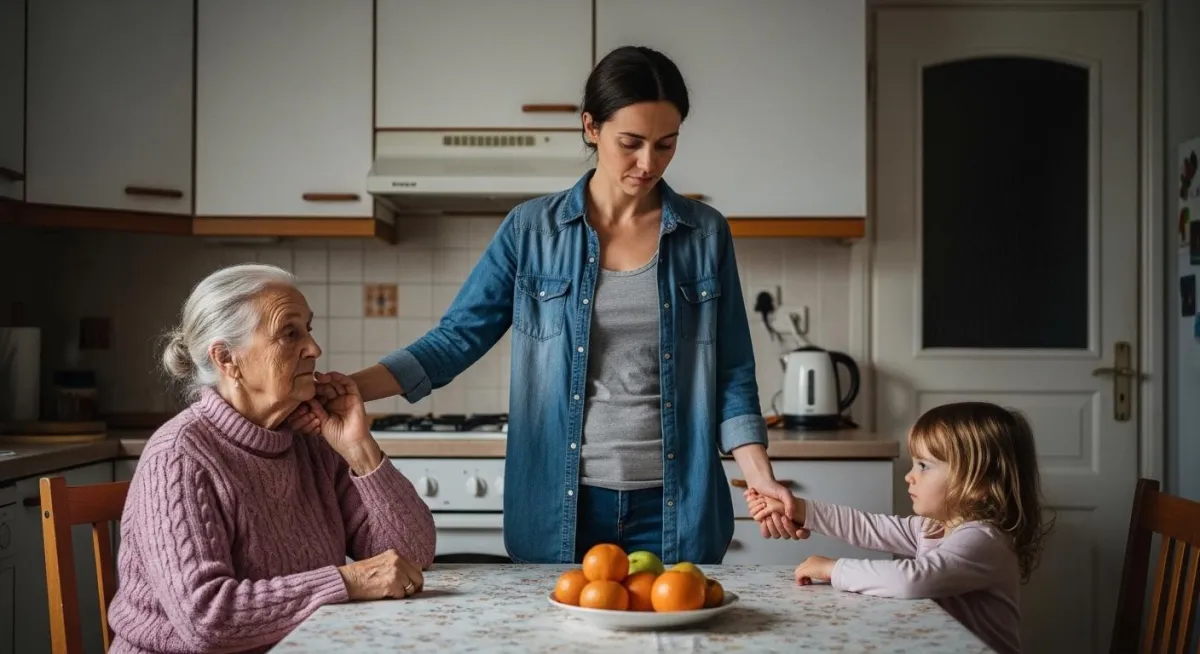
There's a particular tiredness that doesn't come from doing too much, but from holding too much. It lives in women who are daughters and mothers at the same time. Women who answer the phone, show up, remember, soften, translate. Women who sit in the middle, between generations, absorbing what isn't said as much as what is.
They love their mothers.
They adore their children.
And somewhere in between, they're quietly trying not to disappear.
Naming the Pattern
This is the emotional load no one names. It's not just the logistics, though those are real. It's the emotional attunement.
The sensing of your mother's needs before she voices them. The careful way you manage conversations, so no one feels abandoned. The silent promise you made to do things differently with your children, even while you're still healing yourself.
You become the bridge.
The translator.
The emotional container for more than one generation.
Why This Pattern Makes Sense
This role didn't arise because you're weak or overly sensitive. It arose because you're perceptive.
Many women learned early how to read emotional weather, to notice shifts in tone, mood, energy. In families where feelings were unspoken or overwhelming, someone had to become the stabiliser. From a relational perspective, this is often described as relational responsibility: the belief that maintaining connection is your job.
Women are often socialised to define themselves through care and responsibility for others, long before they're invited to centre their own inner lives.
Carol Gilligan
It makes sense that you learned to hold everyone together. You were taught that love looked like care, and care looked like self sacrifice.
The Cost of Staying Here
The cost isn't always obvious. It shows up as:
- Guilt when you assert a boundary
- Resentment you judge yourself for feeling
- Grief for the mother you needed but didn't always have
- Confusion about where your needs even fit
Many women feel ashamed for wanting space, as though it means they are ungrateful or unloving. But this isn't a failure of love. It's a sign of emotional overload. You were never meant to carry every generation alone.
A Different Way of Relating
There is another way to hold these relationships, one that doesn't require withdrawal or hardening. It begins with loosening the belief that your worth is measured by how much you carry.
You can love your mother without parenting her. You can guide your children without abandoning yourself. You can be connected without being consumed.
This isn't about choosing one role over another. It's about allowing your own needs to take up space alongside everyone else's. Not all at once. Just enough to notice what changes when you stop holding your breath.
What would it feel like to let yourself be supported,
even a little, instead of always being the support?
You don't have to answer that today. Just notice what your body does when you imagine it.
This is the work we move into slowly, through the webinars, the reflective workbooks, and inside the Inner Circle, where women are no longer asked to be the emotional bridge alone.
You were never meant to hold everyone.
You were meant to belong, too.


