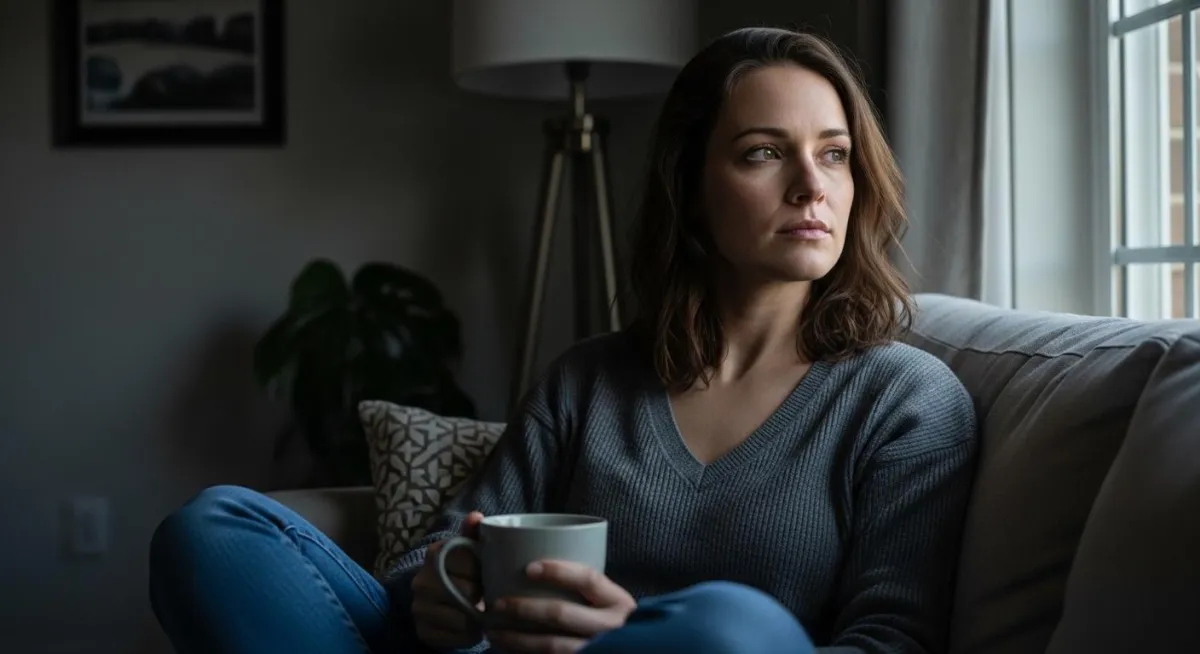
Reflection
The Cost of Being the
"Good Girl" No One Talks About
Why being the reliable one is costing you more than you realise
I've noticed that the women who hold everything together rarely look like they're struggling.
They're the ones who remember the birthdays, smooth the edges, keep the peace.
They're capable. Calm. Dependable. The ones others lean on.
And often, they don't complain, not because it's easy, but because somewhere along the way
they learned that being easy to deal with was safer than being honest.
You might recognise her.
You might be her.
Naming the Pattern
This is the quiet pattern of the "good girl." Not the caricature. Not the cliché.
But the woman who learned early how to be agreeable, helpful, emotionally attuned,
and just a little bit invisible.
- She doesn't demand much. She anticipates instead.
- She doesn't raise her voice. She regulates the room.
- She doesn't always know what she needs, but she's very good at noticing what everyone else does.
Why This Pattern Makes Sense
This didn't come from nowhere. For many women, being easy was adaptive.
It kept connection intact. It reduced conflict. It earned approval, or at least avoided disapproval.
In families where emotional expression was unpredictable, or where harmony mattered more
than honesty, being the "good one" made sense. From a nervous system perspective, it was intelligent.
From a relational one, it was protective.
The quiet weight of holding everything together
"
True belonging doesn't require us to change who we are.
It requires us to be who we are.
— Brené Brown
The trouble is, many women were never shown that version of belonging.
The Cost of Staying Here
The cost isn't loud. It's cumulative. Over time, the good girl begins to feel:
- Quietly resentful
- Emotionally tired without knowing why
- Unseen, even while being appreciated
- Disconnected from her own voice
Burnout doesn't always arrive as collapse. Sometimes it arrives as numbness. Or irritation.
Or the sense that life looks fine on the outside but feels oddly flat on the inside.
What once kept her safe begins to cost her aliveness.
A Different Way of Relating
There is another way, and it doesn't require rebellion, withdrawal, or blowing anything up.
It begins with noticing. Noticing where you soften your truth before it's even formed.
Noticing where you say "it's fine" when it isn't, even to yourself.
Noticing the subtle tightening in your body when you consider asking for more.
You don't have to change everything. You don't even have to speak yet.
Sometimes the most radical shift is allowing your inner world to exist without immediately editing it.
Where in your life are you being good
when you're actually longing to be real?
You don't need an answer today. Just the permission to notice.
If this resonates, it's something we explore more deeply in the work,
through the webinars, the reflective workbooks, and inside the Inner Circle,
where women practise belonging without performing.
No fixing. No rushing. Just a steady return to yourself.
Inner Work
Breaking Family Patterns
Without Breaking Yourself
What didn't start with you, and what doesn't have to continue
There's a moment many women reach, usually quietly, where they realise they're standing
at the edge of something. Not a dramatic rupture. More like an internal pause.
They look at their family, their history, the way things have always been done…
and feel a tension they can't quite name.
A love that is real.
An ache that is also real.
And the unsettling thought:
If I choose differently, will I still belong?
Naming the Pattern
This is the pattern of inherited loyalty. It shows up as staying silent to keep the peace.
As carrying emotional roles that were never formally assigned.
As feeling responsible for how others feel, even when it costs you.
It's the belief, often unspoken, that separation equals rejection,
and that choosing yourself might mean betraying where you come from.
So you adapt. You absorb. You hold the line, even when it hurts.
Why This Pattern Makes Sense
Family patterns don't persist because people are weak.
They persist because they once kept someone safe.
In many family systems, loyalty ensured survival: emotional, social, even physical.
Belonging mattered. Exile was dangerous.
Belonging without losing yourself
From a nervous system perspective, staying aligned with the family rhythm, even when it was
misaligned with your truth, was a form of protection. Psychiatrist and family systems pioneer
Murray Bowen described this as differentiation: the capacity to remain emotionally
connected while maintaining a sense of self.
Most of us were never taught how to do both.
So we learned to fuse… or to disappear… or to do everything in the hope that love would remain intact.
The Cost of Staying Here
The cost of inherited loyalty is rarely immediate. It shows up over time as:
- Chronic doubt in yourself
- Resentment that feels unjustified
- A sense of being "too much" or "not enough," depending on the room
- Exhaustion from holding emotional contradictions alone
Many women don't realise they're tired from carrying history, not just their own lives.
And the longer this goes unnamed, the harder it becomes to imagine another way of being
that doesn't feel like abandonment.
A Different Way of Relating
There is a gentler possibility, one that doesn't require cutting ties or burning bridges.
It begins with understanding that honouring your family does not require you to erase yourself.
You can respect what shaped you and acknowledge what no longer fits.
You can feel compassion for the past without repeating it.
You can belong, differently.
This isn't about confrontation. It's about internal safety.
Because awareness alone doesn't break patterns. Safety does.
And safety grows when you allow yourself to remain connected to others
without leaving yourself behind.
Where are you being loyal to a pattern
that no longer needs you to carry it?
You don't need to act on this yet. Just notice what arises when you ask.
This is the terrain we explore together, in the webinars, the reflective workbooks,
and inside the Inner Circle, where choosing differently doesn't mean choosing alone.
You are allowed to honour where you come from
and become who you are.